It is the rate of heat transfer between a solid surface and a fluid per unit area per unit temperature difference.
Example: The convection heat transfer coefficient is crucial in calculations.
en: Coeficiente de transferencia de calor por convección
Critical Reynold’s number
Noun
It is the Reynolds number in which the flow becomes turbulent.
Example: Viscoelastic effects can substantially lower the critical Reynolds number of parallel shear flows.
en: Número crítico de Reynold
Friction Coefficient
Noun
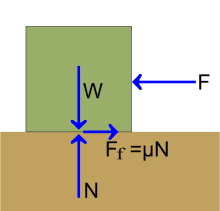
It is a dimensionless coefficient that links the opposition to sliding offered by the surfaces of two bodies in contact according to the intensity of the mutual support they experience.
Example: The coefficient of friction is calculated from the force being used and the amount of friction.
en: Coeficiente de fricción
Kinematic viscosity
Noun
Is a measure of the internal resistance of a fluid to flow under gravitational forces.
Example: Kinematic viscosity is determined by measuring time in seconds.
en: Viscosidad cinemática
Laminar flow
Noun
It is the movement of a fluid when it is ordered, stratified or smooth.
Example: A study is made of the laminar flow in the neighbourhood of the trailing edge of an aerofoil at incidence.
en: Flujo laminar
Nusselt number
Noun
Is a dimensionless number that measures the increase in heat transfer from a surface.
Example: The Nusselt number is determined taking into account the heat transfer and the diameter of the particles involved.
en: Número de Nusselt
Prandtl number
Noun
Is a dimensionless number proportional to the quotient between the diffusion speed of the moment quantity and the thermal diffusivity.
Example: The Prandtl number of a fluid gives the relative importance of the momentum boundary layer to the thermal boundary layer in the transfer of heat.
en: Número de prandtl
Reynold number
Noun
Is a dimensionless number used in fluid mechanics, reactor design, and transport phenomena to characterize the motion of a fluid.
Example: The dimensionless Reynolds number plays a prominent role in foreseeing the patterns in a fluid’s behavior.
en: Número de Reynold
Shear stress
Noun
Is the internal or resultant stress of the stresses parallel to the cross section of a mechanical prism.
Example: Osteoblasts respond to various mechanical forces, including mechanical strain and fluid-induced shear stress.
en: Esfuerzo cortante
Turbulent flow
Noun
It is the movement of a fluid that occurs in a chaotic way, in which the particles move in a disorderly manner.
Example: In general it can be said that there are two types of flows: a laminar flow and a turbulent flow.